

LAGUNA HONDA HOSPITAL: A RESIDENT'S PERSPECTIVE...
Saturday, July 13, 2013

Wednesday, July 10, 2013
TEACH HIM TO FISH!
Old
Saying

---We can apply this old saying of Lao Tzu to what is now happening in our times and situation. We can substitute many things in the ‘’teach him to fish’’ part. It seems that making folks…’’self-reliant’’ is the call of the day. People without skills seem to be called to the wild.
.
---I’m proposing a plan to address both scenarios, simultaneously, that makes those involved to be ‘’better people’’ on ALL sides of the equation. That would be to teach skills and abilities that increase the person in his realization that he is alright to begin with and he doesn't need someway to escape into being drunk or stoned or anything else for that matter.
---Through this idea of teaching people skills + abilities that are relevant to our present society and can then open the doors to increased learning on the subject if so desired. 1] Folks would then be more self-aware and know themselves better THEREFORE less likely to wage war in the first place. 2] Folks would be taught to fish (taught skills) that help tame ‘’a Call of the Wild’’ DOWN TO ‘’a Call to Deal With the Present...Successfully.’’
.
---I feel that a way to teach people to fish is to work with the decision-making skills. For years decisions were made for the resident (old + new hospital + living environment of both) depleting the resident/patients own decision-making abilities and skills in the meantime. Many folks are at LHH through addictions, excesses and other avoidable whatnot. Had they been taught which are the good berries to eat and which are poisonous berries…they, probably, would NOT have been here to begin with.
---I feel WE cannot strip folk of any decision-making skills that they may have had and send them out ill-prepared and naked…to face MANY or ANY of the newly evolving elements…as we see them today. I think a concerted effort to give the residents/patients some kind of skills and abilities makeover so he'll be better equipped to face what HE may face in the society at large. Any type of recitivism TOO SOON, just defeats the saving of money...that seems to be what we are trying to accomplish in the first place. Two negatives don’t make a positive in the way it is being done at present...in our city. It JUST increases the negatives.
Sunday, July 7, 2013
''RESIDENTOLOGY 101'': Two Case Studies
Two
Cases That Illustrate/Illuminate
‘’RESIDENTOLOGY
101’’
---I have two separate scenarios that illustrate
the dilemma I stated in ‘’RESIDENTOLOGY 101’’. It is the situation that says:
To Enjoy Living – We MUST Be Heard + Taken Seriously. If we are not heard and
taken seriously we spend most of our time trying to be heard and taken
seriously. When we feel that both are in place, then we can get on with the
business of enjoying living.

CASE 1.] A woman who has bouts with dementia was looking for the elevator. Though I don’t have privy to her chart, I know that she wanders at times and doesn’t find her way back to her room. I’m sure that keeping her away from the elevators is a good thing. An important piece is that it was July 5 (Friday) and a skeleton crew only opens essential parts of the hospital.
---The woman was aware of a regular appointment she has on most Fridays. It was canceled due to it being the 5th of July. She didn't know this. She wanted to go on the elevator to the appointment which had been canceled.
---She kept asking the duty nurse where the elevator was and she was always sent in a wrong direction due to her wandering history. The woman was becoming more labored, more frustrated and more confused in the process. I encountered her trying to find the elevator in my room. I said I’m heading there and noticed how out-of-breath she was. I was instructed not to show her the elevators and witnessed her being sent in the opposite direction.
(The Saving Grace) – She showed up at the nurses desk with a ZEN Volunteer…who listened to why she felt she had to find the elevator. The charge nurse reassured her that her appointment had been canceled and that she was becoming frantic for no real reason. She was told, but may have forgotten. One could see how relieved that she was at the news. She, finally, could relax. She could enjoy life, again…as she felt her situation had been heard and taken seriously.
CASE 2.] This is a scenario that involved me more
directly. I was to have a floater on this particular day. My consistent care
nurse had not come to work. The medication nurse was, also, not someone who I work
with very often. Floaters, in general, do not know your routine and as far as
rapport goes, you, the patient do not know their quirks and how they do
things.
CASE 1.] A woman who has bouts with dementia was looking for the elevator. Though I don’t have privy to her chart, I know that she wanders at times and doesn’t find her way back to her room. I’m sure that keeping her away from the elevators is a good thing. An important piece is that it was July 5 (Friday) and a skeleton crew only opens essential parts of the hospital.
---The woman was aware of a regular appointment she has on most Fridays. It was canceled due to it being the 5th of July. She didn't know this. She wanted to go on the elevator to the appointment which had been canceled.
---She kept asking the duty nurse where the elevator was and she was always sent in a wrong direction due to her wandering history. The woman was becoming more labored, more frustrated and more confused in the process. I encountered her trying to find the elevator in my room. I said I’m heading there and noticed how out-of-breath she was. I was instructed not to show her the elevators and witnessed her being sent in the opposite direction.
(The Saving Grace) – She showed up at the nurses desk with a ZEN Volunteer…who listened to why she felt she had to find the elevator. The charge nurse reassured her that her appointment had been canceled and that she was becoming frantic for no real reason. She was told, but may have forgotten. One could see how relieved that she was at the news. She, finally, could relax. She could enjoy life, again…as she felt her situation had been heard and taken seriously.
---I have been spending much time in bed, lately, dealing with potential bedsores gotten from spending too much time in one position in my wheelchair.
---I was informed by the medication nurse of how things are going to be and at what times they are going to take place. I mentioned how inefficiently things are being set up for me and according to her plan...I’ll be jumping in and out of bed (which isn’t easy for me to do) all morning. I said that if she would just hear me out…we can resolve this.
---I told her that when she feels it is her time to talk she finds it easy to dictate her way of seeing things to the resident/patient. She always has NO problem in telling him that it is his turn to listen. When the tables are turned and it is now, the patient' turn to talk…she immediately begins assuming and wants to end the conversation. I indicated that I didn’t feel that that is at all fair. I said that I do not always just blow smoke and have nothing of consequence to say. I then told her of times that would work better for me.
---We touched fists and I hope that we have a new respect...born this morning. I (somewhat) felt heard and taken seriously…and (somewhat) could then get on with living. I didn't spend the morning trying to figure a way to be heard and taken seriously by her…I felt that she in someway heard how I was feeling about it all (in a clear + calm manner) and I was in someway now freer from worrying about it. It seems that we have a longway to go, but some progress was made.
---From a RESIDENT'S PERSPECTIVE…I think that these
are important points. I think that many times the resident/patient is not heard and
taken seriously. He has a lot to say, but is very out of practice or simply
never has told his story. And, the best that he has even makes MANY of the 99% avoid him. BUT…when this communication
happens, the resident/patient involved
begins to grow and flourish. AND THINGS ARE CHANGING. I just hope that the fragile momentum he has...can
withstand the nay saying that seems to come with most things. Be Well.
Thursday, July 4, 2013
The Importance of the Decision-Making Process
Decision-Making

(Many Residents)
---Decision-Making is a very important function of
the growth of the human being. We make choices all-the-time. When we find
ourselves in that ''choiceless awareness'' where ‘’BEING HERE’’ is the buzzword...that's great. When we are
being in the present moment and, basically, going with that...we feel like we are on top-of-the world. This, UNFORTUNATELY, doesn't happen all too often.
---Another form of being WITHOUT decisions is in an institutional setting. It is militaristic in its way. All of the decisions are made by the higher-ups…and it is our job (as the underling)…to follow them. Much of the time it is ‘’NO questions asked.’’ This has a very controlling element.
--The second scenario is the one that LHH uses. As much as there is a claim to being resident-centered and a shift to a ‘’Resident-First’’ and ‘’Individualized Care’’ mindset…it is only lipservice and NOT put into practice…to any great extent.
---The long and the short of it is that LHH, DPH, OSHPD and the fire Marshall and everyone else seems to have a say in our living situation EXCEPT those who, actually, inhabit the facility.
---It is written in the literature that making decisions is an important thing. It opens the door to self-knowledge and self-awareness. That begins the journey that is most important to good mental acuity which seems necessary for seniors... especially.
---He then has increased
self-knowledge (self-esteem) and is on his way to actually make more sound decisions that lead
to self - confidence, self-reliance and more autonomy in ones life. All he has to do (for the most part) is to learn to make decisions. Over time he gets better at it and is more
able to think for himself and he will be more wholly rehabilitated than just a
mere physical fix-up and sent upon his way. He is more able to live in a place that ''spit'' him out...originally, if that be the case.
---There is some kind of mindset in the whole DPH
system that says, ‘’if the resident gets too comfortable living in a/the
facility…that is in someway wrong.’’ In my way of thinking, if a resident
finally feels comfortable with who he is and can make positive life affirming decisions
that promote life and betters living, he will find himself in a better way to recover. He will probably choose NOT to live in a
nursing facility when there is so much of life to be lived. But, alas…we find
LHH still going in another direction. Someday, I hope that it learns that its
residents have to be properly rehabbed where growth of the whole person is its
main concern. I thought the class on Coping Skills of a few years ago was the beginning of a new era. Though it needed much tweaking...I was HOPING. That has gone by the wayside in its way, also..
(Another Paul H-Passive-Aggressive RANT)
Sunday, June 23, 2013
ZEN HOSPICE VOLUNTEERS
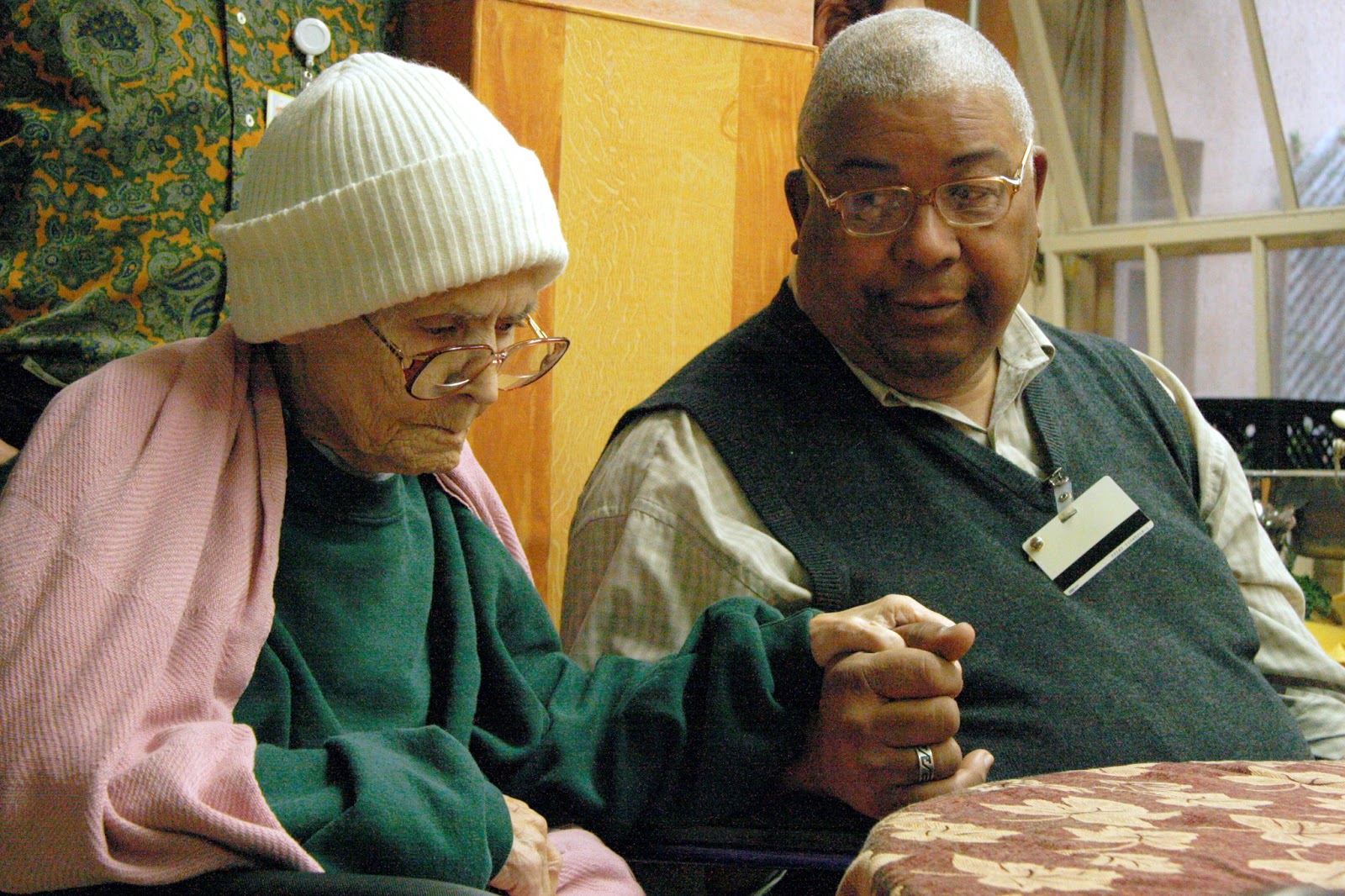
(Eric P. and friend)
Zen Volunteers
---They
have regular assignments and there are usually two or three on every shift. The
whole kit-n-kaboodle is coordinated by Eric Poche, who provides an onsite presence
and all the trainings for new and/or young volunteers who are attracted to this
type of volunteerism. He gets high marks from his ability to quickly explore
ones motives for adding this to his/her journey. His workers have lots of
confidence in what he does.
---Being
as it is that I reside on the hospice, I have the benefit of knowing the Zen Volunteers
very well. (I live on the hospice, but I am NOT a hospice patient.) We have shared liberally over the past year plus…since the move. I
have been involved in many different aspects of LHH. I have attended many
meetings at LHH. One of my recommendations has always been the same. The
residents at Laguna Honda need good-solid people with whom to communicate. The
Zen Volunteers would fill this bill.
---When
I first realized they existed…I immediately thought – how do we multiply this
program to every neighborhood at LHH? Paul Kelley, my social worker says,
‘’there just aren’t enough saints to go around.’’
---The
program is now falling into the jeopardy category. Eric is retiring. Let us all
hope that things pick up around this event. If I had my druthers…programs as
positive as this one would be a priority and NOT fade away. As a
matter-of-fact, I would study the many things that they do right and institute
what it is that they do…so well – HOSPITAL-WIDE. A note to anyone listening ‘’they
communicate…one-on-one. They engage and involve residents.’’ I think that this is
great. Take Care.
---Eric has since retired, but the program is still going strong under Roy R.
Friday, June 14, 2013
Sir Ken Robinson - Escaping Education's Death Valley
---I had my best day ever at LHH. I spent the day with two student nurses from USF. They did nothing out of the ordinary other than oversee my needs and preferences...were very attentive and gave me the human TLC that made my day go very smooth. After lunch we went to see the animals. Nothing extraordinary happened other than they were attentive and conveyed how much (through their actions) they enjoy helping people. It really wasn't an all-day job. They were assigned to get to know me. A ''BIG'' Thumbs-Up.
Sunday, June 9, 2013
Sir Ken Robinson: Bring on the learning revolution!
---I hope that you are all aware of the similarities of Sir Ken Robinson and our own Dr. Victoria Sweet (especially when speaking of Hildegard Von Bingen.) Both use the farming and plant metaphor and the customized environment to maximize the allowing - to give the plant or the child the greatest opportunity to learn and grow.
---It seems that helping others unlearn many of the things that hold back and keep him from real learning, is a good thing. Teaching others to be more innocent...again!
Subscribe to:
Comments (Atom)